
I would like to suggest that there are (potentially) three major components to a Call to Ministry. These three are not independent of each other. Therefore, they are shown like a Venn Diagram.
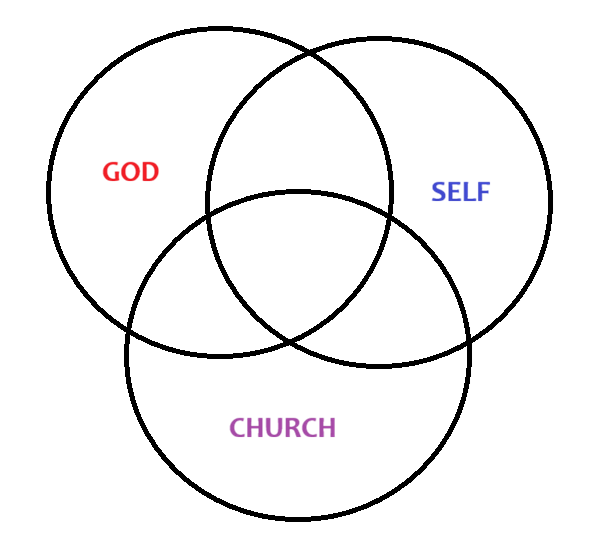
I would like to explore each part separately, with some acknowledgement of the interrelations that may be relevant.
GOD
Many would argue that the most important aspect of being called to ministry is God. In other words, if one is not called by God, then one is not called. And, some might add, if one is called by God, then any other aspect does not really matter.
But it is possible that God is not at all a part of a call to ministry. Or perhaps God is a part, but far from the start, middle, and finish of it. I would at least want to explore this.
Back in 1980, Garry Friesen (with Robin Maxson) wrote a pretty disruptive book, “Decision Making and the Will of God: A Biblical Alternative to the Traditional View.” I attended a fundamentalist Christian college from 1983 to 1985. Friesen came and spoke at our school for a whole week. I found it quite interesting and somewhat compelling. Our school seemed to generally view Friesen’s premise positively. Friesen believed that God had a moral will for our lives, but not a personal will. As such, we had freedom within that moral will to make our own decisions, including whether or not to go into professional ministry. Friesent did note that there were people at times when God unambiguously called them to ministry… but that “unambiguous-ness” is the point. If God is imposing his will into our choices He will not be doing so by “giving me a certain feeling” or “respond to a laying out of a fleece” or other ways that vague and open to interpretation. While people like Isaiah, Moses, and Paul had such unambiguous callings, many ministers in the Bible have no such calling described. Absence of a mention is far from proof that it did not happen, but neither is specific cases of it happening serve to prove that it is normal.
Garry Friesen, described the difficulty of getting ordained in his denomination. Pastors wanted to hear his “calling,” and saying that he did not really believe in a private calling wasn’t considered an acceptable response. A number of pastors in his denomination told him, in essence, if you go into ministry without identifying positively with a divine call, you will fall away under the stress of ministry. Friesen did not find this very compelling. On this particular issue, I would have to agree with him. They seemed to view a call to ministry like a prison. For these pastors I would recommend a better theology.
Still, I am not sure that I fully agree with Friesen. Salvation is relational at its core, and we are told to be led by the Spirit of God. It is difficult for me to see God being disinterested in what we do beyond living within the constraints of morality. On the other hand, a lot of the descriptions of ministerial calling feel weak at best. Some evidence of a divine calling often don’t seem very divine. They seem more as self or church aspects of calling. Some may have been inspired by a person in church, or read a verse that really spoke to their heart. Is that God? Maybe. Is it Church? Self? Who knows.
Perhaps it is better not to force people to express a divine calling. Rather, explore one’s journey of faith as it leads one to ministry. Some aspects of that journey may feel more personal (passion, skill, hope), or church (affirmation, training, encouraging) while others may present as more divine (giftings, “divine appointments,” moments of sudden spiritual insight).
I will give my own testimony of my journey at the end of this discussion. However, I have two more aspects to go over first. I do think my “call to ministry” fits into the model that there are divine, church, and self aspects that all come together. I think my view of calling might be a bit closer to the traditional view than Friesen’s in terms of theory. In other words, I do believe that God does often have a very personal will for us. However, in practice, I may come closer to Friesen. I doubt that it is necessary to lay a fleece, open the Bible to a random verse, pray for a specific word of wisdom or such, to know that one can (or even must) go into ministry.
This will be continued in Part 2


