
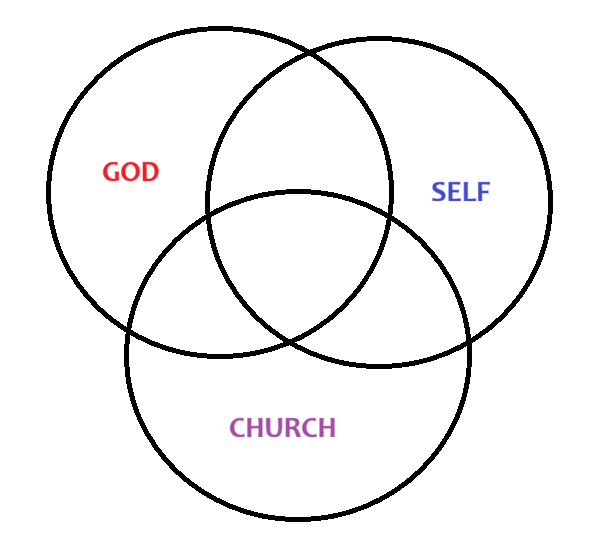
My posts in this series are a bit… all over the place. However, I hope it makes sense when I talk about what I call my call to ministry. But before I do, I would like to talk about the third aspect of one’s Call to Ministry.
SELF
To what extent is a call to ministry a calling of oneself? In my first post Garry Friesen rejected (generally) the idea of a personal calling from God, meaning that his call to ministry seemingly comes from within rather than without. Despite that, he went to great pains to ensure that he was ordained within his denomination— a process that can be seen as a call to ministry, or at least affirmation of a call. He did not need to do that. He could have gone to a denomination or non-denomination that did not care about ordination.
I also noted the movie, The Apostle, where Robert Duvall’s character baptizes himself as “Apostle.” Did he see that as a response to a clear call from God, or an act that only came from his own imagination? I have not seen the movie in so many years I cannot remember if that was parsed out. However, it seems as if the act of baptism (or perhaps ‘rite of purification’) on his part made the calling more real to him.
But if one considers the role of self in calling, I think there are a number of components relevant.
First, I do believe that a person can accept or reject a calling. In the call of Elisha in I Kings 19, it seems clear (to me at least) that Elijah believed that Elisha genuinely had a choice to accept or reject the call. Matthew 8 has two people who want to follow Jesus but Jesus warns them that they must sacrifice more than they (up to this time) have. The implication in the text is that they were unwilling to do this. I also believe the implication is that were willing they would be disciples of Jesus in a way that is unique from the regular crowd. The regular crowd could seek the Kingdom of God while not, yet at least, setting everything else aside. It may seem unfair to use Old Testament examples or ones from the Gospels— both from before the formation of the church. However, the Hebrew Bible and the stories of Jesus were the scripture of the early church. In the early church the stories of Apollos and John Mark appear to be examples of where God’s unambiguous prior call to ministry do not apply. It seems as if Apollos felt called before he was even a full believer. Again, most of these stories depend on how one chooses to read them.
But that may be the point. And this brings up a point. Many in the church over millennia have developed theologies of calling that simply appear to be wildly speculative. One of the more annoying, from my perspective, is the one that was promoted by Peter Wagner. He saw there being two very supernatural callings that relate to Christian missions. One is the Missionary Call, and the other is the Apostolic Call. This is not the place for me to go into all the problems I have with this— but much of the problems we see in the Evangelical movement in the United States have some footing in this theology. Most of these speculative theologies do seem to fall apart when bumping up against the seeming practice of calling in the Bible.
Second, I do believe that Call to Ministry is also tied to how we are designed— our skills, gifts, talents, passions, experiences and more. We are co-designed, by God and by ourselves. Neither part can be ignored. For example, my time in the US Navy led me to really appreciate places outside my homeland. I also enjoy reading and teaching. These are part of who I am. Additionally, and I am simply being honest here, I am not particularly motivated to evangelism. Don’t get me wrong, I think it is wonderful when someone counts the cost of being a disciple of Christ and takes that step on faith. However, I am (being honest again) much more excited when an immature believer grows in faith and passion and develops into a great minister/missionary impacting the world. These personal aspects are not tangential to the call to ministry. They are very much vital to my overall understanding of calling.
Third, the call to ministry is commonly a process of self-reflection. Returning to my seminary, students are supposed to be able to verbalize their own call to ministry (from God) and also have written affirmation from their home church of their call to ministry. However, when I would talk to students on campus, I would hear something very different. Many, perhaps most, of the students see their time in seminary as a time to understand their calling and understand what it means to be called.
Identifying a call to ministry as being something that is only from God or only from the Church, or simply a combintation of from God and the Church is not how it tends to really be experienced.
MY STORY
Perhaps telling my story (a greatly abbreviated version) might make it clearer how I see the Call to Ministry as an interaction of Divine action, Church action, and Personal response and action.
I came from two churches that took missions very seriously. One was my mom’s church, a part of the Christian and Missionary Alliance denomination. My mom, in fact, went to Nyack Missionary Training College with the intent of becoming a missionary. She did not go into foreign missions, but even into her 70s she expressed an interest in still going to serve God in the mission field. My dad came from an Independent Baptist church. Such churches can vary regarding missions, but our church took it very seriously. I thought being a missionary would be “really cool.” Still, my skills were more math and science, and I felt that I should follow my dad’s path which was a mechanical engineer.
In college, I attended a missionary conference that was especially inspirational. I actually walked forward at the call to missions. However, when I spoke with the counselor I said that I truly wanted to follow Christ in service, but also felt that I was not called to missions.
Jumping a few years, I was attending a church that was very missional (giving over half of its budget to missions) where I met Celia who is now my wife. She was a nurse but had wanted to be a missionary– even being accepted to Moody Bible Institute for her training. Ultimately, she was unable to attend there due to financial and family responsibilities.
I eventually was a mechanical engineer for a major corporation, and I liked what I did well enough. But one day, I had an ugly realization. I was talking to one of my friends, a fellow engineer, who was talking about some engineering projects that he was working on at home… FOR FUN! Thinking about some other coworkers I knew, I realized something about myself. The second I left work, I flipped off a switch in my head regarding engineering and did not switch it on until I walked in the door to work. When off work I thought about family and Christian ministry. My wife and I were involved with teaching Sunday School, leading Bible Study, and supporting Christian missions. I realized that I was a good engineer, but I would probably never become great at it, because it was absolutely not my passion. Must one always have one’s job as one’s passion? Of course not, but it is wonderful when that happens.
One day, in 2002, I got an email from our senior pastor. In the email he said that his vision for us, my wife and I, that within 2 years we would either be on the church staff or serving God supported by the church somewhere else in the world. Our pastor was not one who self-identified as being a prophet or anything. I think he was just encouraging us to reflect on this possibility and to affirm us in it.
And we did reflect on it. We actually went through a three-stage process. We embraced the idea that we were (first) called to explore missions. After that we believed that we were (second) called to plan for missions. After these two we did not embrace the idea that we would absolutely go into missions. But the positive process did encourage us in that direction.
Part of the process is that we did explore some mission agencies. Particularly, we applied to our denomination’s primary mission organization. Things were going well until they slowed down our process because I was “chubby.” While I was on “chubby time-out” the mission agency ran out of money and put everyone on hold. Updating our pastor on the situation, he said that he believed the church would be willing to help us go if we could take care of some aspects of mission work that the church cannot do for us. Since we had eventually decided to go to Celia’s birth country (Philippines) we did not have problems with staying in the country. We also were able to get training while in the Philippines at a seminary near my wife’s family house. Our church did decide to commission and support us.
Things were coming together but we still were not sure. I decided to do one of those things that people sometimes do to get God to talk to them. (I am not recommending this… I am simply reporting what happened.) I prayed God would “give me a sign” and then opened up the Bible and pointed to a verse randomly. It was a pretty positive verse— I don’t remember the exact verse, but imagine something like “Be strong and courageous.” That was pretty good, but maybe not good enough? So I repeated what I did the first time and got another pretty positive verse. Again, I don’t remember the exact verse, but something along the line of “I will neither leave you nor forsake you.” That was pretty remarkable, but I really wanted one more time, so I repeated it. This time, I remember clearly what verse I got. It was the passage where Jesus got mad and people continually asking for a sign and refused to give them another one (except the sign of Jonah). I took that as “Stop asking me and get on with it.
Celia and I sold our house, and by March 2004 (just about 2 years after the email from our pastor) we were on our way to the Philippines. However, we still did not like to identify ourselves as missionaries. We were students at seminary but had no formal training, yet, in missions. We were not so much missionaries but people trying to learn what being a missionary means. For the first year or two we did not call ourselves missionaries. The first ones to call us missionaries were Filipino Christians, but they were calling us that because we were “foreign.” The second ones to call us missionaries were Korean missionaries, but they did not really know us well enough to judge us. During our 2nd year in the Philippines, a third group began to call us missionaries. These were American missionaries. We felt they were going to be the toughest group to evaluate us, so if they called us missionaries, we should start calling ourselves missionaries.
So if I had to pick a time when I received my call to ministry, I would probably say that it primarily happened from around 2002 until 2005. However, there is an aspect of it that was lifelong.
While the coolest and weirdest part was when I was picking random verses in the Bible, if someone decided to go into ministry based only on that, I would really have to question that. And if being called/commissioned by their church was their only basis for calling, I would be certainly concerned for that as well. And those who seem to be driven only by a personal passion without any evidence of something more are genuinely lacking.
I see my calling as the interaction of God, Church, and Myself (or my wife and I since we needed to make the decision together). Separating these three aspects I feel is deeply flawed. Because of this, I don’t ask people about their call to ministry, I ask about their personal and ministerial journey. I believe that is where the true call is found.


