
I am going to make an argument that is pretty obvious when one thinks about it… but I am doing so for a reason. But for now, let me play “Captain Obvious.”
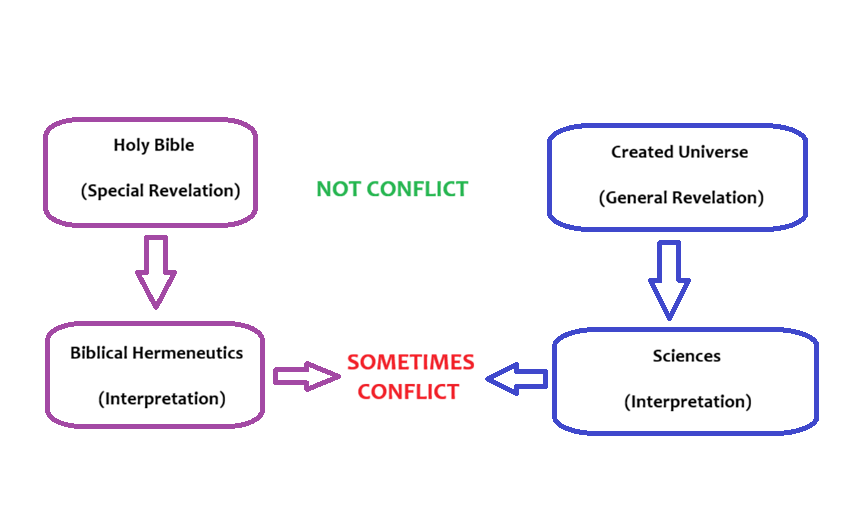
It is worthwhile to parse out a statement that people say. Some people like to say that the Bible conflicts with Science. Some say that, from the Science side, the Bible has problems because of this conflict. On the other hand, some Christians may say that this conflict shows that Science is wrong.
Without picking a side here, I must note that the initial statement is incorrect. As a Christian, I would describe the Holy Bible as being special revelation. That is, it is a primary way in which God broke into our world to reveal Himself. Also as a Christian, I would describe the universe around us as created by God, and as such it is a general revelation.
Pretty much by definition, special revelation is not in conflict with general revelation. I am not saying this as a Christian… suggesting that since they both came from God, they cannot be in conflict. I am simply noting that a rock, a black hole, or a tomato plant is not (cannot be) in conflict with a word, sentence, or book, at least not the type of conflict we are concerned about. Conflicts we are concerned about are in ideas, and ideas are of the mind. (I told you I am playing Captain Obvious here.)
The conflict of ideas occurs in the realm of interpretation. If someone says that the Bible conflicts with Science, they really mean, “A (perhaps common) interpretation of the Bible conflicts with a (perhaps generally accepted) scientific theory.”
Why does this matter?
- When there is a conflict between an interpretation of the Bible with Science, it is POSSIBLE that the interpretation of the Bible is wrong. One should consider that possibility.
- When there is a conflict between an interpretation of the Bible with Science, is is not a conflict with the Created World. It is possible that Science (as it is presently understood) is wrong.
- Frankly, it is pretty doubtful that any interpretation of the Bible is perfectly correct or that any interpretation of the created world in the sciences is perfectly correct. Therefore, in almost any area of seeming conflict, it is almost certain that both are in some ways wrong and in need of correction.
This is not an argument that brings us closer to truth. In fact, the same arguments here could be made about any religion and Scripture with any scientific (or pseudoscientific) paradigm.
Rather, the modest goal is to clarify the nature of the conflict. Consider the issue of the age of the earth. Some people say that there is a clear conflict between the Bible and Science. In truth, the Bible never says how old the earth is. There is an interpretational argument for seeing the Bible as suggesting a young age. However, again, that is a matter of interpretation… one which many do not hold as accurate. It is also true that Science as an interpretation of the created (or natural) world can be in error. In fact, Science cannot “prove” (a very loaded term) that the universe existed yesterday. The world we live in may be a simulation complete with the artifacts of age and false memories of the past imprinted in our memories. If that sounds far-fetched (much like a world that is only a bit over 6000 years old with the natural and artificial evidences of age). If any of this sounds foolish to you, I have no reason to argue with you. I will note that Bible interpretation and the interpretation of the sciences does change, and will continue to change. Locking in a past interpretation as having embraced absolute truth is unhealthy.


