<I took a break from posting to clean up my old posts. I have gone through all of my posts from the beginning in 2009 to the end of 2012. I deleted around 100, and touched up the rest.>
Leviticus 19:33-34 seems to have become a popular verse recently, at least in the United States. Some people keep referencing it in complaining about some of the politics going on there (or here, since I am in the US presently), while others are trying to explain why they are not violating the “letter of the law” in their own politics regarding immigration.
I must note that the verse is NOT about immigration law, at least not directly. So when the verse is used to judge government policies, both sides are (kind of) missing the point. That being said, I do think one side has a lot less mental gymnastics to justify. My understanding of the passage is very much drawn from my experiences as a foreign missionary.
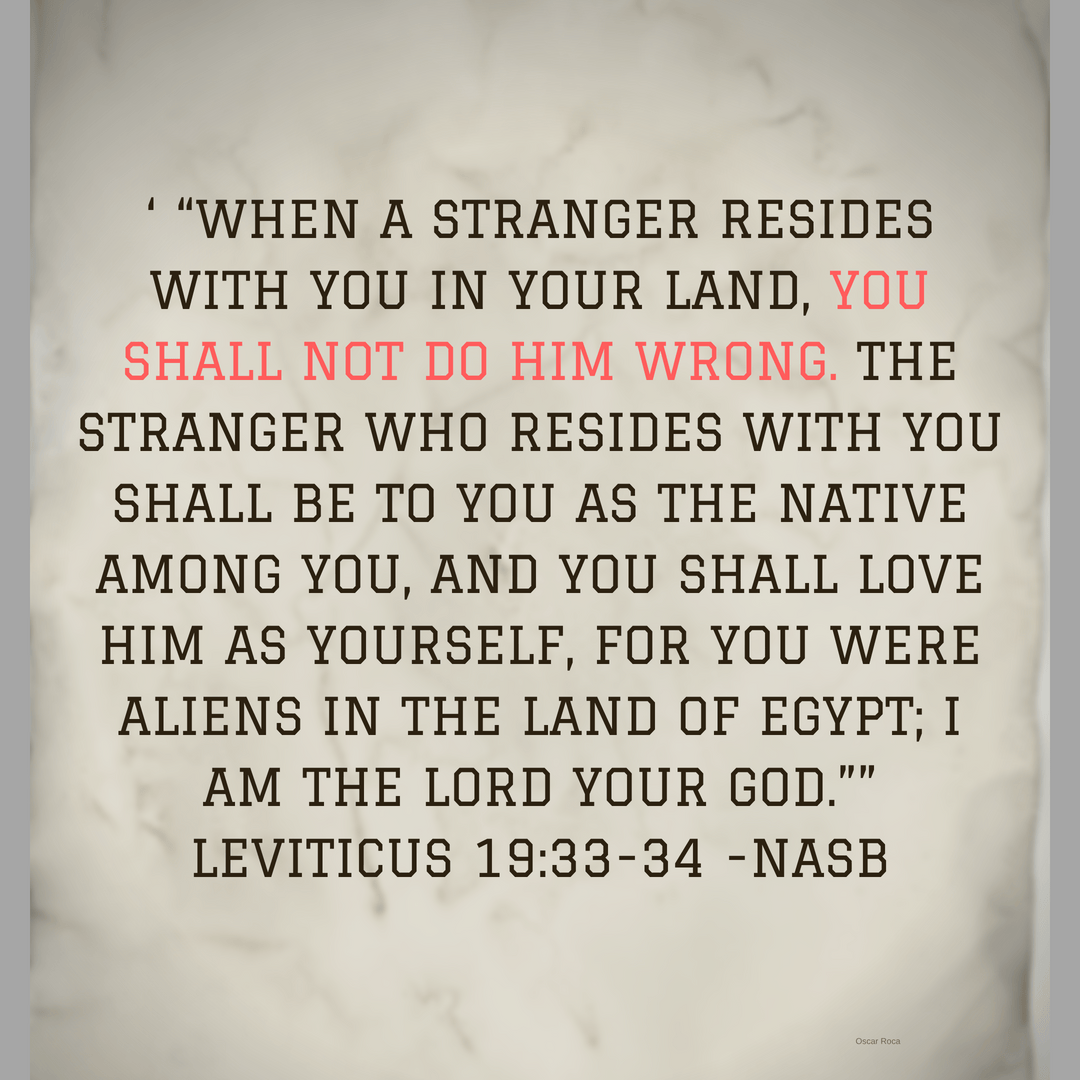
But is that appropriate? My situation as a foreign missionary is very different from the perspective of Israelites in the Wilderness. Reading verse 34, however, there seem to be two justifications. One is because… God is God. God is essentially saying, “Do it, because I said so.” The other is that the Israelites were aliens in Egypt. Their experiences as marginalized aliens in their “home” should give them insight into how important it is to be kind and loving to aliens in their own land.
With that in mind, here are some of my experiences.
- I have lived in the Philippines from 2004 until 2025 (I hope to return, but family responsibilities are taking priority currently). Americans typically are treated well in the Philippines, and my experience has been no exception. This is surprising since the US came into the land in 1898-1899 and then refused to leave— taking it as an overseas territory (which sounds better than stolen-land colony). Only in 1946 did the American government leave (not including military bases, which remained by agreement for a few more decades). Filipinos could certainly justify treating me poorly, I am sure, but I can probably only count on one hand all the bad experiences I have had in the country that might be related to my being a foreigner. I have been to countries where I felt very foreign and unwelcome, but those were from a time well before I went into missions. Perhaps some of the problem was me. Anyway, I think it is beneficial to live in a community of people of a different nationality, race, ethnicity, or language— preferably not merely as a short-term visitor. I believe that would greatly add to one’s empathy for those who are different when the roles are reversed.
- In the Philippines, I was not merely an alien over those years, but for a few months I was an illegal alien. Back in March of 2020, my family was preparing to fly back to the US when the Philippines went into lockdown. I was stranded. The rest of my family were dual citizens, so it was nothing more than an inconvenience for them. I, however, was not a Philippine citizen, so a couple of months into lockdown, I overstayed my visa. There was no immigration office I could go to. I just waited for government offices to reopen. I finally went in around 8 months after my visa expired. Everyone at immigration was very friendly. I had to fill out a form and pay a fee. I was then given an extension to my stay. My previous experience at the Bureau of Immigration, years before, was not so positive. The guy in charge said I had to pay money for some paperwork (which I did not). Then he tried to pressure me into paying for another thing that I also did not have to pay for. I successfully resisted his second effort but acquiesced on the first one— paying a fee that almost certainly just went into the pocket of that official. I was thrilled to see that he was no longer there at Immigration when I went there in 2021. My experiences, legally, living in the Philippines have been mostly positive. (Having a wife who is a dual citizen helps, I am sure.) I know stories of friends who definitely struggled because of the vulnerability they have as non-citizens. This gave me insight into the feelings of exposure one has as an alien in a land where the laws are primarily designed to protect citizens, leaving others vulnerable. It also helped me not be too quick to judge people whose status may not be seen as legal. <By the way, while I know there are many illegal aliens in the US, it is quite surprising how many aliens, including American aliens, there are living illegally in the Philippines.>
- During my first or second year in the Philippines, I kept hearing people talk about a perceived threat in Baguio City. Many Muslim Filipinos from Mindanao and the Sulu Archipelago have been moving to Baguio. Most of them are coming to escape violence and grinding poverty in the south. However, for many of the, predominantly, Christian residents of Baguio City, including many pastors, this migration was seen as a threat— even an invasion. Many were talking about the Muslims (Moros) as moving to Baguio to establish a Sultanate. I argued, especially with the pastors, saying that we should welcome the Muslims. It is a great opportunity for local churches to minister to the outsiders. Christians often speak positively about sending Christian missionaries off to predominantly Muslim nations. But in this case, they were coming here. What a blessing! I will note that over the years, the attitude has changed in many churches, and there are numerous churches and Christian NGOs that minister to the Muslim population of Baguio City. Looking back, I realize that the local people/pastors of Baguio were not bad Christians, and I was not simply “more enlightened” than they were. Rather, as locals, they felt the fears associated with the threat of losing position, power, and prestige within the culture. I heard stories of what great lengths some Christians in Baguio went to in trying to prevent a mosque from being built. As an outsider, I didn’t get it. (I must note that, curiously, some foreign Christian missionaries joined this pointless effort.) Why should Christians be bothered that a different religious population in the city has a place of worship? The mosque, however, was a symbol of the threat of disempowerment and replacement. I am Caucasian (“Swedish-American”) and I know many who look like me who seem genuinely worried about losing power and privilege in the US to other races (the infamous “Replacement Theory”). I feel that my being a disempowered outsider helped me see perception of threat from an alternative perspective. Not only that, but I think everyone would benefit from living in a setting of disempowerment.
Leviticus 19:33-34 notes that the Israelites’ previous status of being disempowered aliens should help them understand how to obey God more effectively. Other verses include:
Exodus 22:21 – “You shall not wrong a sojourner or oppress him, for you were sojourners in the land of Egypt.”
Exodus 23:9 – “You shall not oppress an alien, for you know the heart of an alien, since you were aliens in the land of Egypt.”
Deuteronomy 10:19 – “So show your love for the alien, for you were aliens in the land of Egypt.”
I hope more Christians will get to have their Israelite in Egypt moment.


